
A lot of people see the circle of fifths, panic, and decide music theory isn't for them. Here's a secret: it's one of the friendliest things in all of music. It's not a test you have to pass — it's a helper that quietly answers the two questions every musician asks: "what notes go together?" and "which chords sound good?" By the end of this article you'll actually get it. We'll go slow, use a clock, and try it for real in the Music Theory Decoder app.
What Is the Circle of Fifths?
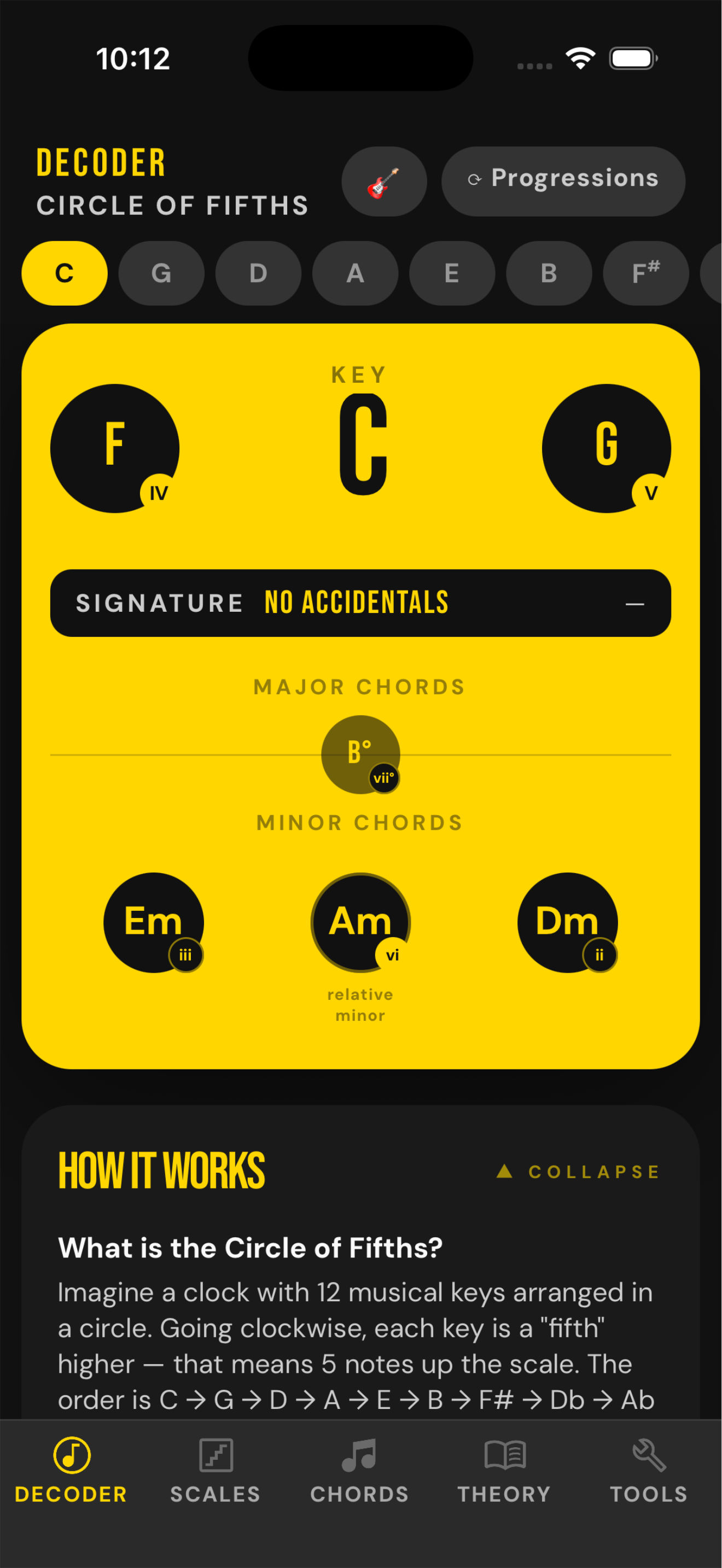
Picture a clock. But instead of the numbers 1 to 12, every spot on the clock has a musical note on it. Twelve notes, arranged in a circle. That's the whole idea. The app says it in one sentence: "Imagine a clock with 12 musical keys arranged in a circle."
Just like a real clock helps you tell time, this musical clock helps you tell which notes are related — which ones are close neighbours, and which ones live far apart. That's it. You already understand the shape. Now let's find out why it's so useful.
Why Is It Called "Fifths"?
Good question — why not just "the circle of notes"? The name comes from how you walk around the circle.
Start on the note C. Now count up the musical alphabet, five steps, like counting houses on a street:
C (1) → D (2) → E (3) → F (4) → G (5)
You landed on G. Because G is the fifth note up from C, we say G is "a fifth above C." And look at the circle again — G is the very next stop, just clockwise of C. Every single step around the circle does the same thing: it jumps up a fifth.
Clockwise: C → G → D → A → E → B → F#…
Counter-clockwise (going down a fifth): C → F → B♭ → E♭…
It's like skipping along a street and always landing on a neighbour who happens to sound great standing next to you. That "sounds great next to each other" part is the magic, and we'll get to it.
The Scorekeeper: Sharps and Flats
Every song has a key — its home base, the note everything feels pulled back to. Each key uses a slightly different set of notes. Some keys have a few sharps (the # sign), some have a few flats (the ♭ sign).
Here's the gift: the circle keeps score for you, so you never have to memorise it. Starting from C at the top (which has no sharps or flats at all — the app literally says "No accidentals"):
Take one step clockwise, and the new key adds one sharp.
Take one step counter-clockwise, and the new key adds one flat.
So you never have to remember "how many sharps does the key of A have?" You just find A on the circle, and it tells you. The circle is basically a cheat sheet that's allowed in every exam.
The Best Part: Which Chords Sound Good Together
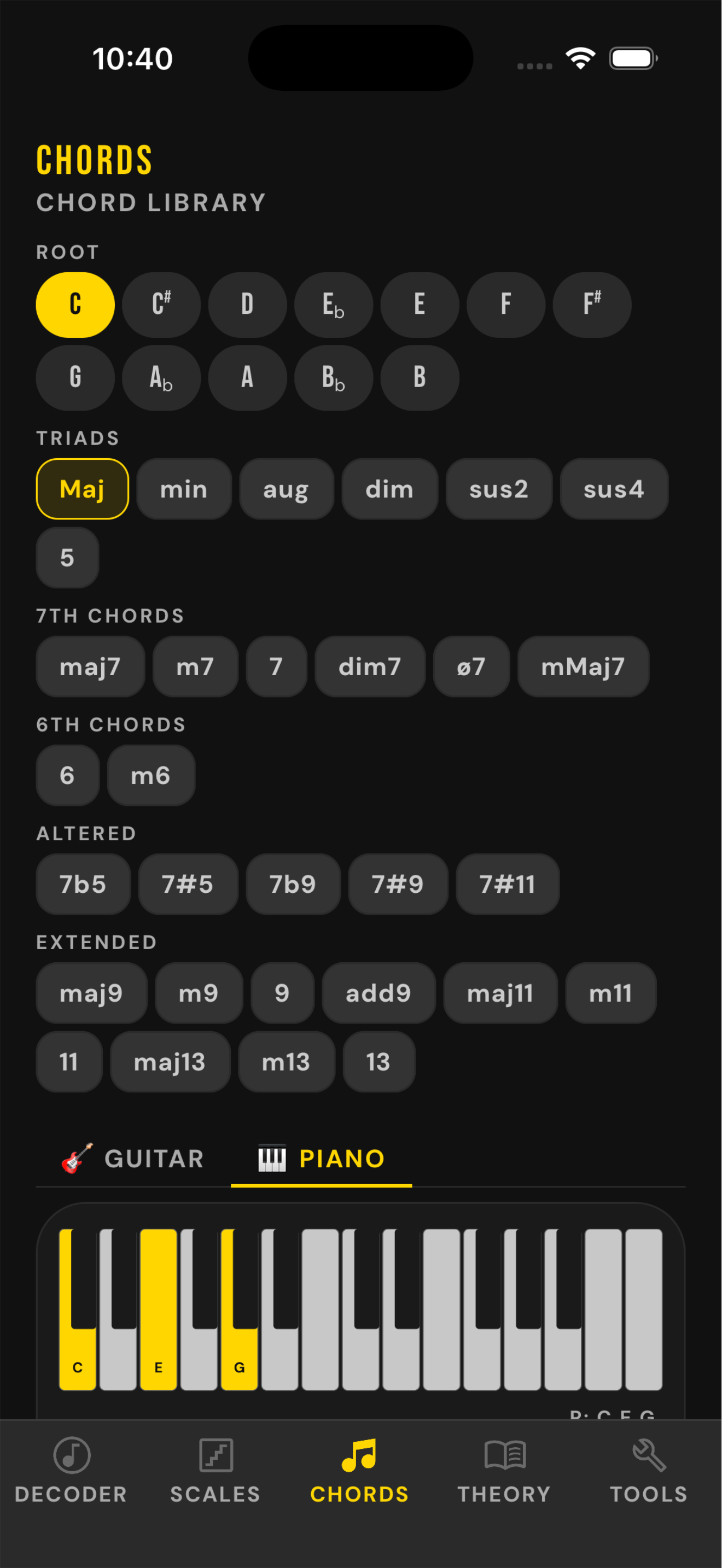
This is where the circle earns its fame. Pick a key — let's stay with C. The notes sitting right next to C are its best friends:
The neighbour to the right (G) and the neighbour to the left (F) are the two chords that almost always sound great with C. Musicians call them the "five" (V) and the "four" (IV).
Every happy-sounding major key also has a quieter, more emotional twin called its relative minor — it uses the exact same notes. For C major, that twin is A minor. The app even labels it "relative minor."
This is the reason so many famous songs use only three or four chords: those chords are all neighbours on the circle, so they naturally belong together. Once you can spot the neighbours, you can guess the chords to a huge number of songs.
From Chords to Scales to Whole Songs
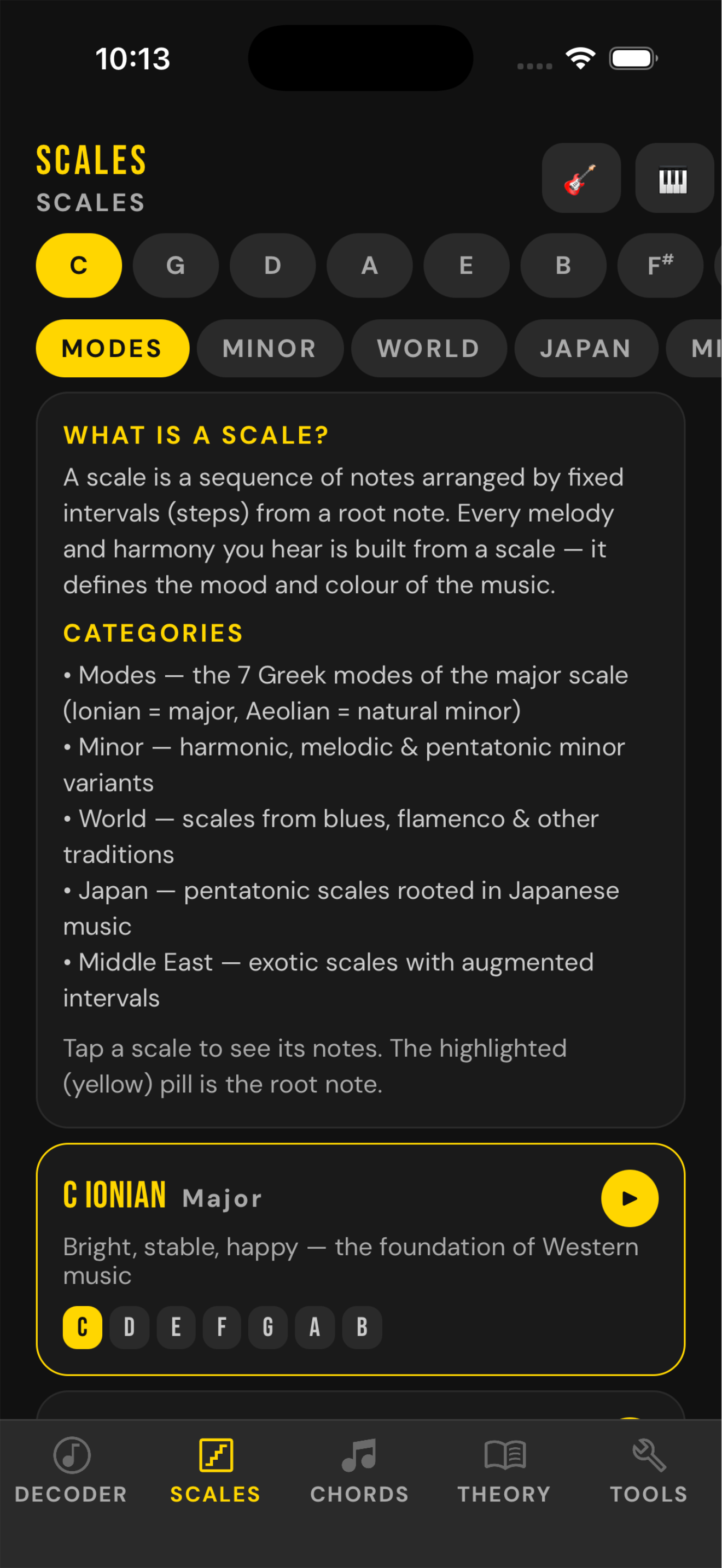
Once the circle tells you the key, you also know the scale — the little family of notes you're allowed to use that all sound right together. Key, scale, and chords are really three views of the same thing. Put them together and you have the recipe for a song.
That's the whole journey: a clock face → a key → its scale → its chords → a song. The circle of fifths is the map that ties all of it together.
You Don't Have to Memorise Any of This
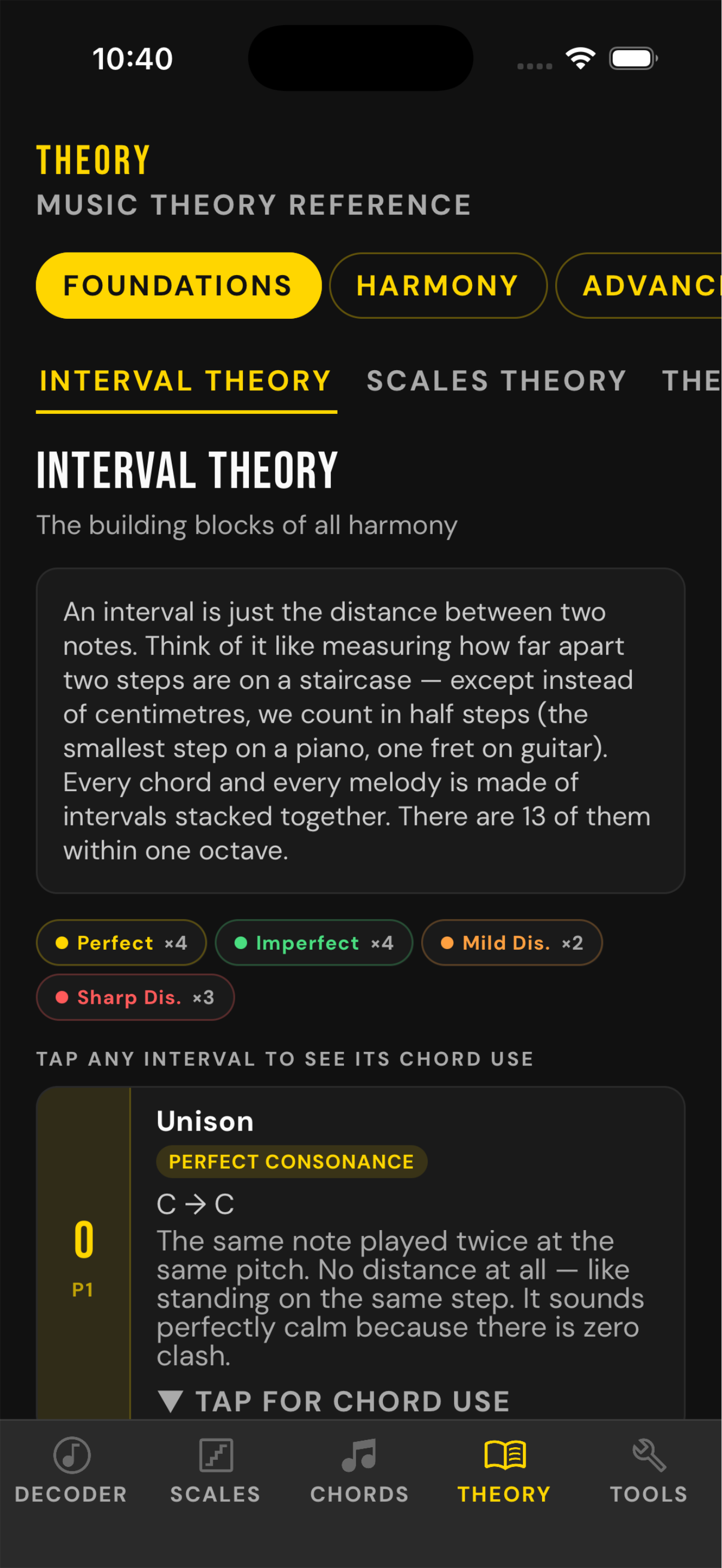
Here's the honest truth that nobody tells beginners: even professional musicians keep the circle of fifths nearby. Nobody holds all twelve keys, their sharps, and their chords in their head at once. The goal isn't to memorise it — it's to be able to read it.
That's exactly why we built Music Theory Decoder. It puts an interactive circle of fifths in your pocket. Tap any key and it instantly shows the sharps or flats, the chords that fit, and the relative minor — all the things we just talked about, without a single thing to memorise. It also includes a full chord library, 20 scales, and a built-in theory reference written in plain English.
Hear It, Don't Just Read It
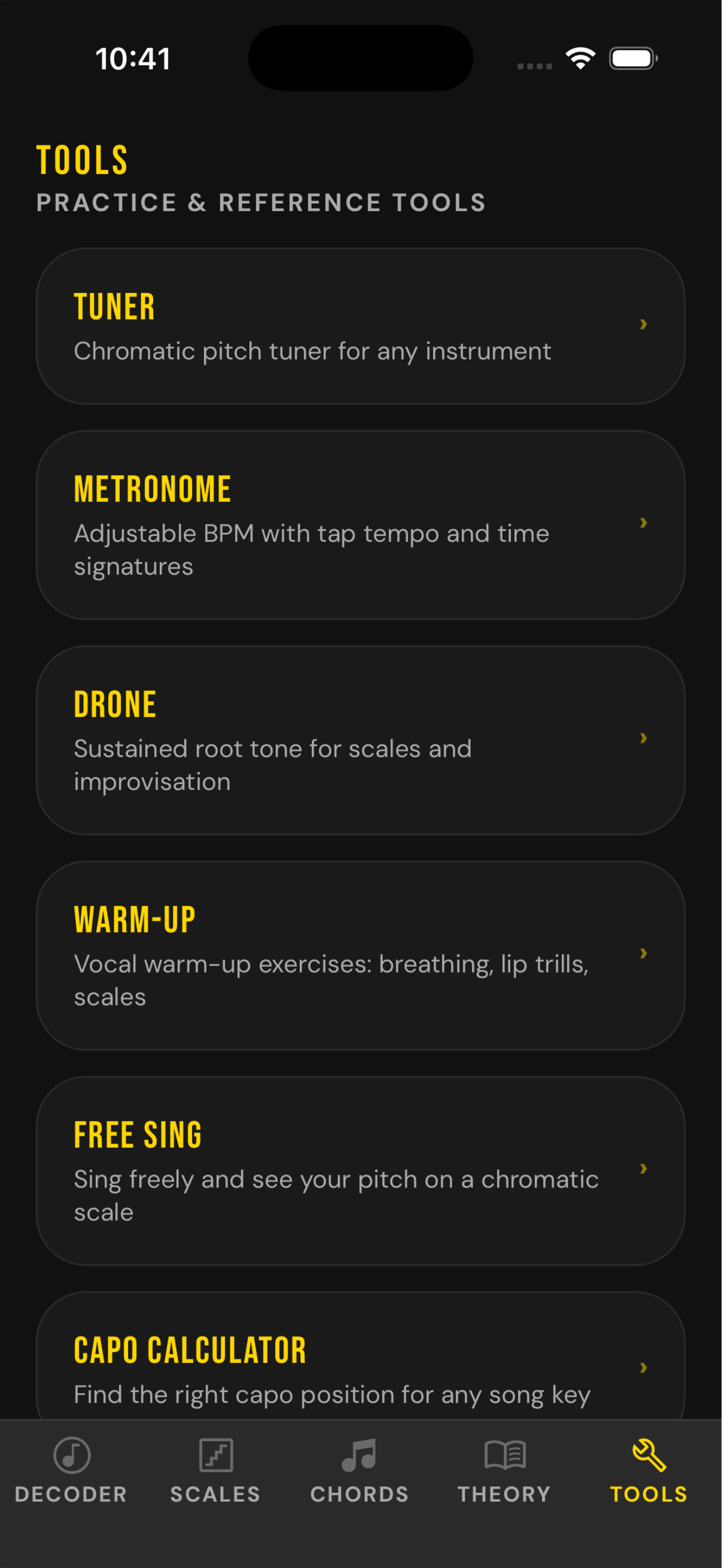
Theory finally clicks when you can hear it. The app's toolkit lets you play with sound directly: a chromatic tuner, an adjustable metronome, a drone you can sing or solo over, and a free-sing mode that shows your pitch as you go. Pick a key on the circle, hold its drone, and hum along — suddenly "the key of C" stops being words on a page and becomes a feeling in your ears.
The Takeaway
The circle of fifths isn't a scary diagram you need a degree to read. It's a friendship map for notes: it shows who's related, who sounds good together, and which notes each key uses. Learn to read it once — even with a little help in your pocket — and a surprising amount of music suddenly starts to make sense.
Want to try everything in this article for yourself? Tap a key, watch the chords light up, and let the circle do the remembering for you.